> ## Documentation Index
> Fetch the complete documentation index at: https://docs.sqlbuild.com/llms.txt
> Use this file to discover all available pages before exploring further.
# dlt
> Declarative dlt sources in YAML, or full dlt pipelines inside Python source loaders.
[dlt](https://dlthub.com) is an open-source Python library for loading data from APIs, databases, cloud storage, and more. SQLBuild integrates with dlt two ways:
* **Declarative dlt sources** - configure dlt directly in your source YAML, no Python code. SQLBuild runs the dlt pipeline as part of the build lifecycle. Best for the common REST API, SQL database, and filesystem cases.
* **dlt inside a Python loader** - wrap any `dlt.pipeline(...)` in a SQLBuild [source loader](/concepts/python-nodes/loaders) for full control when you need dlt features beyond the declarative surface.
## Install
```bash theme={null}
pip install 'sqlbuild[dlt]'
# or
uv pip install 'sqlbuild[dlt]'
```
This installs dlt with the `duckdb`, `filesystem`, and `sql_database` extras alongside SQLBuild.
## Declarative dlt sources (YAML)
Declare a `dlt_sources` list in a `sources/*.yml` file. Each entry has a `type`, a `config` block passed to the dlt source, and a list of `resources` that become SQLBuild managed sources. SQLBuild generates a synthetic loader per resource and writes into the database its adapter manages, no Python and no destination setup required.
Supported source types: `rest_api`, `sql_database`, `filesystem`.
 ### REST API
```yaml theme={null}
# sources/github.yml
dlt_sources:
- type: rest_api
config:
client:
base_url: https://api.github.com/
headers:
Authorization: "Bearer ${github_token}"
paginator:
type: header_link
resources:
- name: raw_github_issues
write_disposition: append
endpoint:
path: "repos/${github_owner}/${github_repo}/issues"
params:
state: all
per_page: 100
```
`rest_api` requires `client.base_url` in `config`. Each resource needs an `endpoint` mapping; the dlt resource name comes from `endpoint.name` if present, otherwise the resource `name`.
### SQL database
```yaml theme={null}
# sources/postgres.yml
dlt_sources:
- type: sql_database
config:
credentials: "${postgres_connection_string}"
resources:
- name: raw_customers
table: customers
write_disposition: merge
primary_key: id
```
`sql_database` requires `credentials` in `config`, and each resource requires a `table`.
### Filesystem
```yaml theme={null}
# sources/files.yml
dlt_sources:
- type: filesystem
config:
bucket_url: "s3://my-bucket/events/"
resources:
- name: raw_events
write_disposition: append
```
`filesystem` requires `bucket_url` in `config`.
### Resource options
| Key | Description |
| --------------------------- | --------------------------------------------------------------------------------------- |
| `name` | Source name SQLBuild exposes (referenced via `__source("name")`). Required. |
| `table` | Source table to replicate (`sql_database` only). Required for that type. |
| `endpoint` | Endpoint mapping (`rest_api` only). Required for that type. |
| `write_disposition` | dlt write disposition: `replace`, `append`, or `merge`. `merge` requires `primary_key`. |
| `primary_key` / `merge_key` | dlt keys for `merge`. |
| `incremental` | dlt incremental config mapping (e.g. cursor column and start value). |
| `schema` | Per-resource schema override (falls back to the group `schema`). |
Use SQLBuild's `write_disposition` (dlt's term), not `write_strategy`. `delete_insert` is not available declaratively; use a Python loader for that. Config values support SQLBuild's [interpolation](/concepts/interpolation): `${name}` for a project variable, `${ENV:NAME}` for an environment variable, and `${CTX:...}` for context, resolved at load time, so credentials stay out of the YAML.
### Destination
By default each resource loads into the database SQLBuild's adapter manages, with the dataset/schema derived from your target. An optional `destination` mapping passes extra settings to the dlt destination, but it cannot set `credentials`, `dataset_name`, or `default_schema_name` (SQLBuild manages those):
```yaml theme={null}
dlt_sources:
- type: rest_api
destination:
loader_file_format: parquet
config:
client:
base_url: https://api.example.com/
resources:
- name: raw_widgets
endpoint:
path: widgets
```
### Reference in models
Declared resources are managed sources, reference them like any other source:
```sql theme={null}
SELECT id, title, state FROM __source("raw_github_issues")
```
## dlt inside a Python loader
When you need dlt capabilities beyond the declarative surface (custom transforms, `delete_insert`, sources not covered above), wrap a dlt pipeline in a [source loader](/concepts/python-nodes/loaders). The loader calls `dlt.pipeline(...).run(...)` and returns `None`; dlt handles the writes and SQLBuild treats the source as loaded.
```python theme={null}
# loaders/github_sources.py
import dlt
from dlt.sources.rest_api import rest_api_source
from sqlbuild.loaders import loader
from sqlbuild.executor.load.models import LoaderContext
@loader
def raw_github_issues(ctx: LoaderContext):
source = rest_api_source({
"client": {
"base_url": "https://api.github.com/",
"headers": {"Authorization": f"Bearer {ctx.vars['github_token']}"},
"paginator": {"type": "header_link"},
},
"resources": [{
"name": "issues",
"endpoint": {
"path": "repos/{owner}/{repo}/issues",
"params": {
"owner": ctx.vars["github_owner"],
"repo": ctx.vars["github_repo"],
"state": "all",
"per_page": 100,
},
},
}],
})
pipeline = dlt.pipeline(
pipeline_name="github_issues",
destination=dlt.destinations.duckdb(ctx.connection),
dataset_name=ctx.destination_schema or "main",
)
pipeline.run(source)
```
Bind it to a source with `managed: true` in `sources/*.yml`:
```yaml theme={null}
# sources/github.yml
sources:
- name: raw_github_issues
managed: true
table: issues
columns:
- name: id
type: INTEGER
- name: title
type: VARCHAR
```
### DuckDB connection sharing
With the DuckDB adapter, pass `ctx.connection` to dlt's DuckDB destination to reuse SQLBuild's open connection, so dlt writes into the same database without a separate connection string:
```python theme={null}
pipeline = dlt.pipeline(
pipeline_name="my_pipeline",
destination=dlt.destinations.duckdb(ctx.connection),
dataset_name=ctx.destination_schema or "main",
)
```
### Warehouse destinations
For Snowflake, BigQuery, or Databricks, configure dlt with its own credentials. dlt writes directly to the warehouse, and SQLBuild reads the resulting tables as sources:
```python theme={null}
pipeline = dlt.pipeline(
pipeline_name="api_data",
destination="snowflake",
dataset_name=ctx.destination_schema or "public",
)
```
Configure dlt credentials via its own `secrets.toml` or environment variables, as in the [dlt documentation](https://dlthub.com/docs/general-usage/credentials/setup).
## Build integration
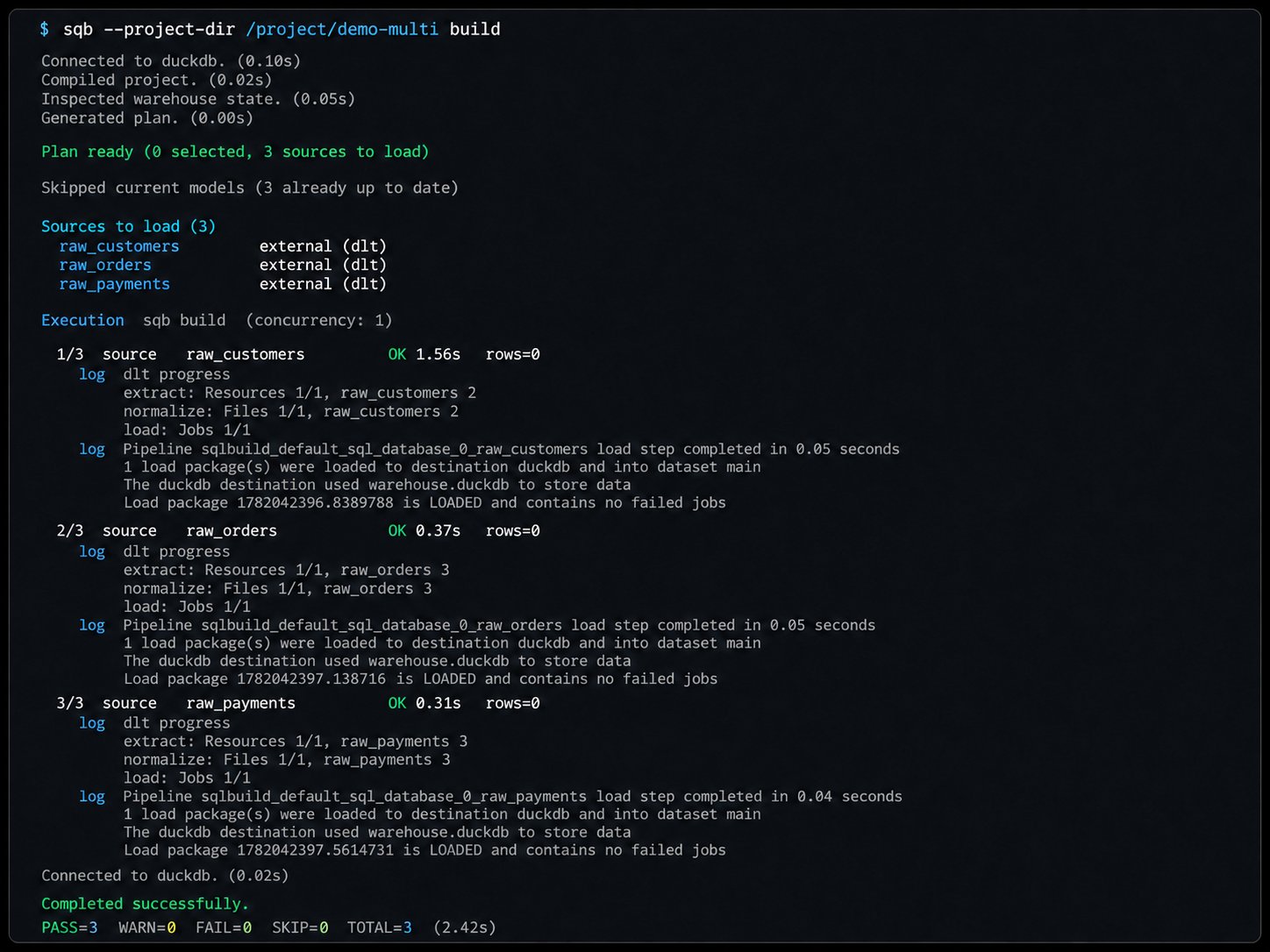
Whether declarative or Python, loaders run automatically during `sqb build` (when `auto_load_sources` is enabled), so dlt pipelines execute as part of the normal build lifecycle:
```bash theme={null}
sqb build # loaders run, then models build
sqb build --no-load # skip loading, use existing source data
sqb load # run loaders standalone
```
See [Loaders](/concepts/python-nodes/loaders) for write strategies, the loader context API, auto-load behavior, and source deferral.
### REST API
```yaml theme={null}
# sources/github.yml
dlt_sources:
- type: rest_api
config:
client:
base_url: https://api.github.com/
headers:
Authorization: "Bearer ${github_token}"
paginator:
type: header_link
resources:
- name: raw_github_issues
write_disposition: append
endpoint:
path: "repos/${github_owner}/${github_repo}/issues"
params:
state: all
per_page: 100
```
`rest_api` requires `client.base_url` in `config`. Each resource needs an `endpoint` mapping; the dlt resource name comes from `endpoint.name` if present, otherwise the resource `name`.
### SQL database
```yaml theme={null}
# sources/postgres.yml
dlt_sources:
- type: sql_database
config:
credentials: "${postgres_connection_string}"
resources:
- name: raw_customers
table: customers
write_disposition: merge
primary_key: id
```
`sql_database` requires `credentials` in `config`, and each resource requires a `table`.
### Filesystem
```yaml theme={null}
# sources/files.yml
dlt_sources:
- type: filesystem
config:
bucket_url: "s3://my-bucket/events/"
resources:
- name: raw_events
write_disposition: append
```
`filesystem` requires `bucket_url` in `config`.
### Resource options
| Key | Description |
| --------------------------- | --------------------------------------------------------------------------------------- |
| `name` | Source name SQLBuild exposes (referenced via `__source("name")`). Required. |
| `table` | Source table to replicate (`sql_database` only). Required for that type. |
| `endpoint` | Endpoint mapping (`rest_api` only). Required for that type. |
| `write_disposition` | dlt write disposition: `replace`, `append`, or `merge`. `merge` requires `primary_key`. |
| `primary_key` / `merge_key` | dlt keys for `merge`. |
| `incremental` | dlt incremental config mapping (e.g. cursor column and start value). |
| `schema` | Per-resource schema override (falls back to the group `schema`). |
Use SQLBuild's `write_disposition` (dlt's term), not `write_strategy`. `delete_insert` is not available declaratively; use a Python loader for that. Config values support SQLBuild's [interpolation](/concepts/interpolation): `${name}` for a project variable, `${ENV:NAME}` for an environment variable, and `${CTX:...}` for context, resolved at load time, so credentials stay out of the YAML.
### Destination
By default each resource loads into the database SQLBuild's adapter manages, with the dataset/schema derived from your target. An optional `destination` mapping passes extra settings to the dlt destination, but it cannot set `credentials`, `dataset_name`, or `default_schema_name` (SQLBuild manages those):
```yaml theme={null}
dlt_sources:
- type: rest_api
destination:
loader_file_format: parquet
config:
client:
base_url: https://api.example.com/
resources:
- name: raw_widgets
endpoint:
path: widgets
```
### Reference in models
Declared resources are managed sources, reference them like any other source:
```sql theme={null}
SELECT id, title, state FROM __source("raw_github_issues")
```
## dlt inside a Python loader
When you need dlt capabilities beyond the declarative surface (custom transforms, `delete_insert`, sources not covered above), wrap a dlt pipeline in a [source loader](/concepts/python-nodes/loaders). The loader calls `dlt.pipeline(...).run(...)` and returns `None`; dlt handles the writes and SQLBuild treats the source as loaded.
```python theme={null}
# loaders/github_sources.py
import dlt
from dlt.sources.rest_api import rest_api_source
from sqlbuild.loaders import loader
from sqlbuild.executor.load.models import LoaderContext
@loader
def raw_github_issues(ctx: LoaderContext):
source = rest_api_source({
"client": {
"base_url": "https://api.github.com/",
"headers": {"Authorization": f"Bearer {ctx.vars['github_token']}"},
"paginator": {"type": "header_link"},
},
"resources": [{
"name": "issues",
"endpoint": {
"path": "repos/{owner}/{repo}/issues",
"params": {
"owner": ctx.vars["github_owner"],
"repo": ctx.vars["github_repo"],
"state": "all",
"per_page": 100,
},
},
}],
})
pipeline = dlt.pipeline(
pipeline_name="github_issues",
destination=dlt.destinations.duckdb(ctx.connection),
dataset_name=ctx.destination_schema or "main",
)
pipeline.run(source)
```
Bind it to a source with `managed: true` in `sources/*.yml`:
```yaml theme={null}
# sources/github.yml
sources:
- name: raw_github_issues
managed: true
table: issues
columns:
- name: id
type: INTEGER
- name: title
type: VARCHAR
```
### DuckDB connection sharing
With the DuckDB adapter, pass `ctx.connection` to dlt's DuckDB destination to reuse SQLBuild's open connection, so dlt writes into the same database without a separate connection string:
```python theme={null}
pipeline = dlt.pipeline(
pipeline_name="my_pipeline",
destination=dlt.destinations.duckdb(ctx.connection),
dataset_name=ctx.destination_schema or "main",
)
```
### Warehouse destinations
For Snowflake, BigQuery, or Databricks, configure dlt with its own credentials. dlt writes directly to the warehouse, and SQLBuild reads the resulting tables as sources:
```python theme={null}
pipeline = dlt.pipeline(
pipeline_name="api_data",
destination="snowflake",
dataset_name=ctx.destination_schema or "public",
)
```
Configure dlt credentials via its own `secrets.toml` or environment variables, as in the [dlt documentation](https://dlthub.com/docs/general-usage/credentials/setup).
## Build integration
Whether declarative or Python, loaders run automatically during `sqb build` (when `auto_load_sources` is enabled), so dlt pipelines execute as part of the normal build lifecycle:
```bash theme={null}
sqb build # loaders run, then models build
sqb build --no-load # skip loading, use existing source data
sqb load # run loaders standalone
```
See [Loaders](/concepts/python-nodes/loaders) for write strategies, the loader context API, auto-load behavior, and source deferral.